The Breville Precision Brewer might look like your typical (albeit pricey) drip coffee maker, but if you’ve landed here, you’re probably wondering what makes it so special. Why is it more expensive than the average brewer? Is it actually worth the money? And should you buy one?
You’re in the right place, because I’m going to answer all of those questions without wasting your time with fluff. You’ll get detailed insights if you’re after the full scoop, but I’ve also got quick answers if you’re just here for the bottom line, coming from someone who’s actually spent a lot of time using the Precision Brewer.
Hi, I’m Kev, coffee nerd, machine tester, and the face behind CoffeeKev on YouTube. I buy every machine I test with my own money, and I’m not paid to make these reviews or posts. That means when I say something’s good (or not), you can trust it’s coming from real hands-on experience, not from a sponsor.
As you scroll through this review, you’ll also find videos from my YouTube channel to help you see the machine in action. Let’s get into it.
Is the Breville Precision Brewer Worth It?
Whether you’re a regular coffee drinker who wants a great drip machine to have a hot pot of coffee ready when you wake up, or you’re a third wave, specialty coffee nerd looking for the best batch brewer your money can buy, I think the Breville Precision Brewer is about as close to perfect as it gets.
Now, is it flawless? Not quite. I wish Breville had done a few things differently, which I’ll go into further down in this full “warts ‘n all” review. But honestly, nothing here is a deal breaker. These are just a few wishlist items that would take it from 95% perfect to a full 100%.
So yeah, I think this is a fantastic drip coffee maker. But I know that’s a big claim, so let me back it up with some real-world proof.
Coffee Roasters Use the Precision Brewer
If you’ve ever been to a specialty coffee event (and if not, I highly recommend checking one out, they’re a great way to taste loads of incredible coffee), you might’ve noticed something interesting: quite a few roasters there use the Breville Precision Brewer.
Now think about that for a second. If you’re a roaster spending time and money to show off your beans at a coffee festival, the last thing you want is a coffee machine that makes your product taste flat or average. So if roasters choose the Precision Brewer, even over much more expensive commercial machines, that’s a big vote of confidence.
When I see that, I take it seriously. These folks aren’t messing around.
James Hoffmann Approves
Maybe you’re wondering, “OK, but who is this Kev guy, and why should I trust him?” That’s a fair question; I sometimes don’t even listen to myself, either!
But James Hoffmann? Now there’s a guy you can trust. He’s one of the most respected voices in coffee; when he speaks, the whole coffee world listens.
So, the fact that Hoffmann used this machine for a couple of years and then raved about it for 12 minutes straight on his YouTube channel, with no major complaints, says a lot. If you trust his judgment, that’s probably all you need to hear.
Quick Summary: What’s Not Great?
If you’re just here for the short version: it’s great, buy it.
But if you’re curious about the downsides, here’s the main thing I don’t love: It doesn’t have a removable water tank. It’s not a huge issue, but it would’ve made things easier.
It’s also a little noisy, but as I explain later (complete with decibel readings), it’s only loud for a few seconds right at the end of the brew cycle. It’s about as quiet as any other drip machine for most of the brew.
Those are the only two things I’d call real negatives, and honestly, they’re not deal breakers. I also include a few more minor nitpicks below, for those of you who like to go deep into the details (like me).
Breville Precision Brewer Review After 3 Years of Real Use
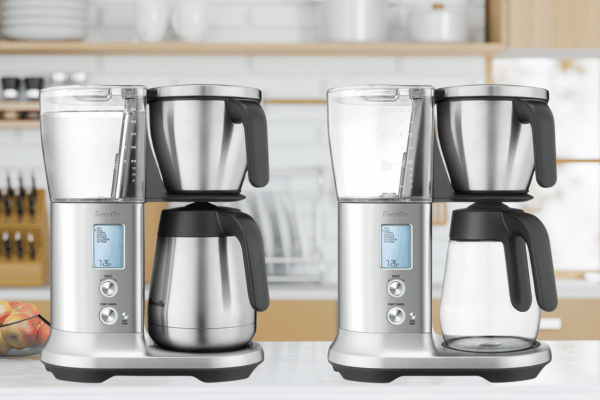
Before diving deeper, let’s quickly clarify something: there are two versions of the Breville Precision Brewer, Thermal and Glass. The difference is just the carafe and heating method.
- The Thermal version has a stainless steel insulated carafe and no hot plate.
- The Glass version has a traditional glass carafe and uses a hot plate to keep coffee warm.
Why I Recommend the Thermal Version
Personally, I recommend the Thermal version for most people. One of my biggest gripes with traditional drip brewers is the use of hot plates. They tend to overheat the coffee and ruin the flavor over time.
That’s what I love about the thermal Precision Brewer: Your coffee stays hot for hours in the insulated carafe, and it tastes just as good as when it was brewed. If you’re set on the glass version, though, don’t worry, aside from the carafe and hot plate, the rest of the machine is identical.
My Experience With the Precision Brewer
I’ve owned the Thermal version of the Breville Precision Brewer for around two years now. I used it heavily when testing for my original YouTube review, and I’ve continued reaching for it whenever I need to batch brew coffee.
By the way, if you’re wondering what batch brewing means, it’s just the specialty coffee term for brewing multiple cups using a drip machine instead of single-cup pour-over methods.
I’ve also recommended this machine to friends, family, and fellow coffee lovers, many of whom aren’t hardcore coffee geeks, and the feedback has been overwhelmingly positive. I honestly can’t think of anyone who hasn’t been impressed by it.
Even among coffee professionals, whenever the Precision Brewer comes up in conversation, those who’ve used it always have good things to say. That’s a rare thing.
What Makes the Breville Precision Brewer So Good?
Here’s a quick overview of what really sets this brewer apart:
- Rare level of control over brew variables
- Simple one-touch settings for ease of use
- Big 60 oz max brew capacity
- Reliable and easy-to-use timed brewing
- Option to use cone or flat-bottom basket filters
- Compatible with pour-over drippers
- Cold brew functionality built in