If you’re looking into the Breville Barista Touch Impress and wondering if it’s worth the investment, you’re in the right place.
Hi! I’m Kev, aka Coffee Kev.
I run the Coffee Kev YouTube channel, where I review coffee machines with no sponsors, no freebies, and no nonsense. I buy every machine with my own money so I can give you an honest, real-world opinion, not marketing fluff.
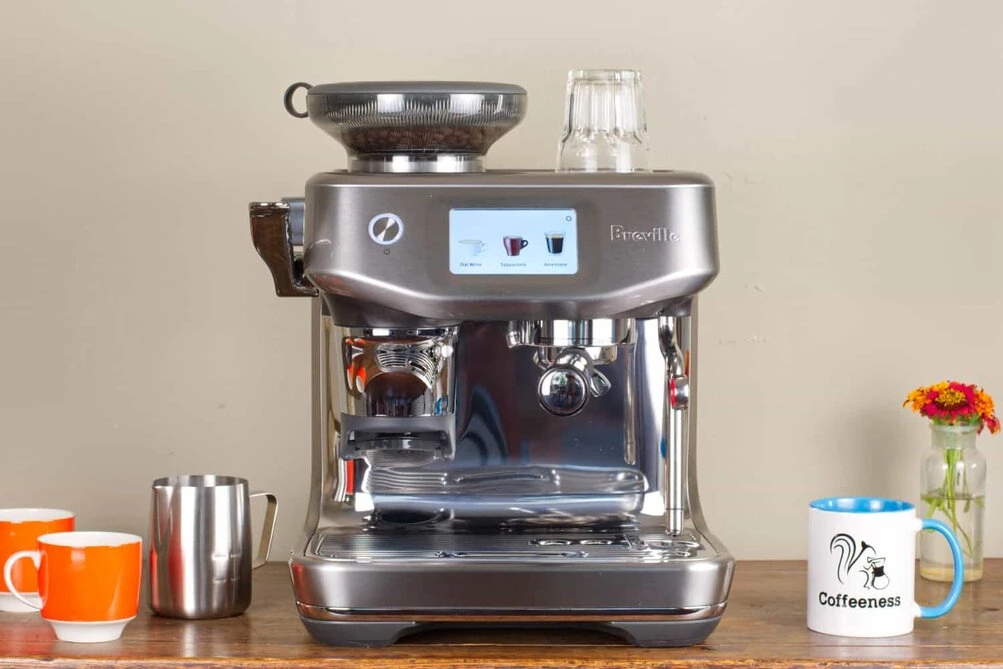
Below this article, you’ll find video clips from my YouTube channel, including my full hands-on review of the Barista Touch Impress, with detailed test results, comparisons, and real-world insights.
Breville is a seriously clever brand. They’ve built a reputation for making some of the smartest and most user-friendly espresso machines on the market, and this latest release takes things to another level. I went into this review expecting precision and polish.
Breville isn’t your average coffee machine brand, far from it. This is a company with specialty coffee at its core, even if that’s not how everyone sees it at first glance.
From Radios to Ristrettos
Breville started way back in the early 1930s in Sydney, Australia. It was founded by:
- Bill O’Brien
- Harry Norville
(Yes, that’s where the name “Breville” comes from, Br from O’Brien and -ville from Norville.)
Their first product? A radio.
Fast-forward to today, and Breville has grown into a global kitchen appliance brand, but make no mistake:
“Not a Specialty Brand”? Think Again
Some home baristas still snub Breville as a “standard domestic brand.” Why?
- Their machines are sleek, kitchen-counter friendly.
- They manufacture in China, which unfairly lumps them into the “budget” category by people who judge by looks or origin.
But here’s the thing:
- Breville was focusing on specialty coffee features long before it was trendy.
- Even in the early 2000s, their machines were shipping with:
- A 9-bar OPV (Over Pressure Valve)
- Brew temperatures hitting the ideal 200°F
- Low-pressure pre-infusion to avoid channeling
These aren’t just marketing checkboxes. These are features aimed squarely at people who actually care about espresso.
The Blessing and Curse of the Barista Express
Breville’s big breakout came with the Barista Express, a machine that looked like a best-of-both-worlds setup:
- The ease and convenience of a super automatic
- The quality and flexibility of a home barista setup
At least, that’s how many retailers marketed it.
But let’s clear this up:
- The Barista Express is not an automatic machine.
- It’s a semi-automatic espresso machine with a built-in grinder.
Retailers kept listing it under automatic machines because it sold like hotcakes. And who can blame them? It still does.
A Quick Geeky Note on Pressure
Now, for anyone into the more technical side of things:
You may have noticed that the Barista Express is the odd one out when it comes to pump pressure. Unlike Breville’s other machines that use a 9-bar setting, the Express runs at something like 13–14 bars.
Why?
I don’t know for certain, but I suspect it’s a workaround for its misplacement in the market. If people are using it like a fully automatic machine, maybe the higher pressure was meant to better handle inconsistent tamping or grind sizes.
Either way, the Express wasn’t meant to be hands-off. It’s a manual machine at heart, and the Touch Impress builds on that legacy in some very clever ways.
Why the Pressurized Baskets?
Another little curveball with the Barista Express, and possibly another clue that Breville knew how their machine was being used, was their decision to ship it with:
- Pressurized (dual-walled) baskets, instead of standard single-walled baskets.
These days, you’ll usually get both types in the box, but initially, I think Breville leaned toward the pressurized ones to:
- Make the machine easier for beginners
- Improve shot consistency for people using pre-ground or supermarket beans
- Work better with that higher pump pressure I mentioned earlier
And yes, that kind of pressure management actually works better with pressurized baskets.
Apologies if your eyes have just glazed over, don’t worry, I’ll try to keep the rest of this post as non-geeky as I can 🙂
Wait, Is the Touch Impress an Espresso Machine?
Just to clear the air for anyone new to this, yes, this is an espresso machine. And if you’re not super deep into coffee geekery (yet!), let me explain why that matters.
I’m writing this for everyone, from casual coffee drinkers to full-on specialty coffee lovers, so let’s start with a simple but essential point:
All your coffee shop favorites, Cappuccino, Latte, Flat White, Americano are built on one foundation: espresso.
So, if you want to make these kinds of drinks at home, you really need an espresso machine, not just a “coffee machine.”
What’s the Deal with Super-Automatics?
Not all espresso machines are the same. Here’s where super-automatic coffee machines come into play:
- They’re called “super-automatic” because they do everything for you.
- They grind the coffee, dose it, tamp it, and brew your espresso with zero fuss.
- They use an internal brewing unit rather than a traditional portafilter.
And yes, they do make espresso, just not in the same way a traditional machine does.
Super-automatics are perfect for convenience seekers. They crank out café-style drinks quickly and easily, and the cup quality is more than good enough for most people.
But… Is It Specialty Espresso?
Here’s the rub:
If you’ve got a well-trained palate or you’re used to third-wave coffee quality, then you might find the espresso from most super-automatics a little… underwhelming:
- Less intensity
- Lighter body
- Less nuanced flavor
That’s because super-automatics tend to sacrifice a bit of control and quality for convenience.